|
Every space of welcome is a threshold — a place where identities dissolve, blend, and reform.
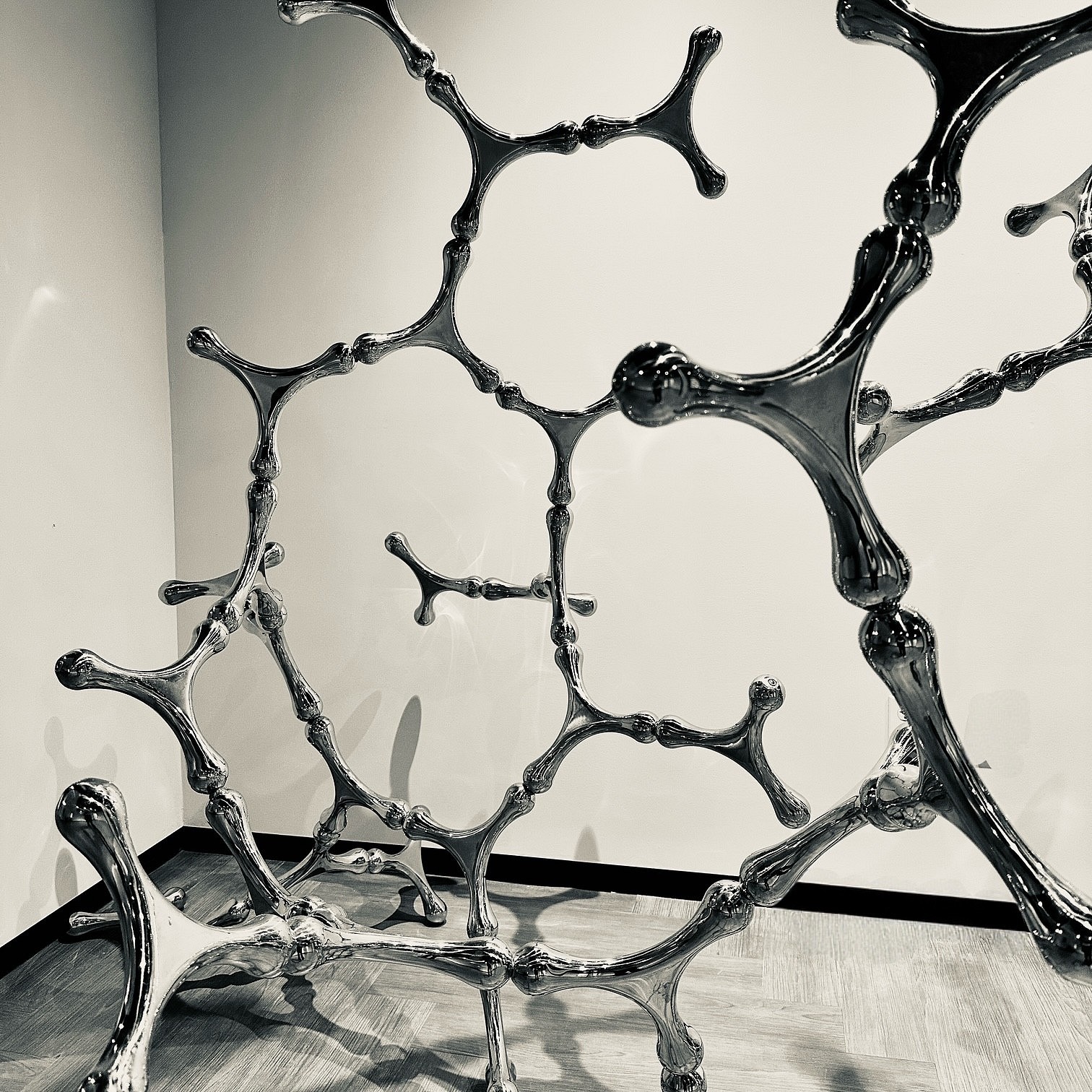
In The Fluid Guest, Loris Cecchini translates this condition into a structure that breathes and flows: a metallic organism that seems to emerge from the wall and, at the same time, dissolve into it. Its forms recall cells, branches, corals — living systems that adapt, grow, and migrate.
The work thus becomes a silent guest, an entity that inhabits space without possessing it, like a traveler who leaves no trace yet subtly alters everything it touches.
The material — gleaming, modular, almost liquid — behaves like water: it expands and retracts, embraces the light, and lets the gaze pass through it.
In this hall, a place of transit and waiting, The Fluid Guest evokes a new idea of hospitality: not one that separates host and guest, but one that recognizes in reciprocal transformation the highest form of encounter.
Waterbones is one of Loris Cecchini’s most renowned series. These are modular installations composed of stainless steel elements that the artist links together to form organic lattices, fluid branches, or cell-like structures that seem to grow spontaneously across walls, ceilings, or open space.
The very title, Waterbones, aptly conveys their dual nature: they are flexible skeletons, biomorphic and metamorphic forms that unite solidity and lightness, structural rigor and fluid motion.
Cecchini often conceives them as expanding systems, where each module is both an autonomous unit and part of a whole — much like in natural or digital networks. Conceptually, the Waterbones embody his exploration of osmosis between art, nature, and technology, translating into visual form the idea of a world in constant transformation, where matter and energy interpenetrate.
Loris Cecchini’s Waterbones can be read as a poem of metamorphosis, a fluid script composed not of words but of nodes, curves, and joints. Their name — “water bones” — already contains a poetic paradox: the union of opposites.
Water, the principle of life and movement, meets bone, the principle of structure and resistance.
In this alliance between the liquid and the solid, Cecchini gives form to something that seems alive but not biological — a possible life, an organism in potential. Each Waterbone is like a multiplying cell, a particle of thought expanding through space, generating a rhizomatic network akin to a nervous system or a coral reef.
It is a cartography of connection, where nothing exists alone: everything interweaves, propagates, transforms. In their luminous silence, the Waterbones recount a poetic physics of interdependence — a universe where the creative gesture coincides with an act of cosmic respiration: each module a breath, each joint a heartbeat, each expansion an act of trust in continuity.
At the heart of a passageway, Loris Cecchini’s work seems to hold the breath of movement.
Its forms, born from the meeting of fluidity and structure, expand like an echo of water that has learned to pause, to take on body. Each module is a droplet that has found its stillness, a fragment of inner landscape that flows without leaving.
In this luminous suspension, matter reminds us that even a journey can rest — that there is a place where the flow gathers and the threshold becomes home. In the hall, where every arrival merges with a departure, the work unfolds as a silent map of movement.
It is a journey that does not cross space, but creates it: an architecture of breath, a constellation of forms opening and closing like an unfinished sentence.
Matter vibrates at the precise point where energy pauses, and stillness reveals its inner motion.
Here, passage becomes contemplation — and transit, for a moment, finds its home.
|